Unblock
Prototype brought under control
Current bench state, known-good checks, fault list, and next-board or next-demo actions.
Send this instead of a CV
I help founders, agencies, and small engineering teams buy outcomes instead of vague time: boards brought up, devices talking, release risk reduced, and technical decisions made with evidence attached.
London based. 15+ years across software, embedded-adjacent systems, product delivery, diagnostics, and technical leadership. External work is kept fixed-scope, conflict-safe, and contracted through Dadalto Software & Consultancy Ltd when commercial onboarding is ready.
Board to bench
KiCad, fab handoff, manufactured prototypes, bring-up evidence.
Device communication
STM32-class firmware, USB, serial, diagnostics, logs, test harnesses.
Product software
.NET, Python, TypeScript, PostgreSQL, CI/CD, release automation.
Risk clarity
SOT Navigator, evidence packs, unknowns, decision memos.

The useful question
Can this person reduce risk fast enough to change the next decision?
That is the bar. The output should be a working path, a testable artefact, or a clear no-go reason, not a long report that avoids the hard part.
Outcome menu
Each offer is designed as a short, agency-like delivery unit: one trigger, one useful output, and one decision that becomes easier afterwards.
Unblock
Current bench state, known-good checks, fault list, and next-board or next-demo actions.
Measure
A small harness, structured logs, pass/fail evidence, and handover notes.
Decide
KiCad-to-fab review notes, debug readiness, test-point thinking, and bring-up plan.
Ship
Critical-flow smoke checks, release evidence, unknowns, and a bounded fix path.
Operating model
The shape is deliberately small: one senior operator, AI-assisted execution, clear acceptance criteria, and specialist partners only when a scope genuinely needs them.
Find the smallest useful problem boundary and visible success condition.
Produce a working artifact, evidence pack, checklist, or scoped fix.
Leave notes, logs, commands, and next decisions clear enough for the team.
Proof areas
The strongest current profile is hybrid: enough electronics to move a prototype forward, enough firmware and tooling to make it repeatable, and enough software architecture to turn the result into a product system.
Board-level delivery from schematic/layout through fabrication handoff, manufactured prototypes, bench bring-up, first firmware, USB/serial diagnostics, and revision evidence.
STM32-class firmware, ESP32-style bench tooling, UART/I2C/SPI/USB-adjacent work, command surfaces, structured logs, repeatable checks, and fault isolation.
C#/.NET, Python, TypeScript, PostgreSQL, Supabase, CI/CD, local simulators, operator tools, dashboards, smoke tests, release evidence, and integration glue.
SOT Navigator produces deterministic software-risk artifacts: evidence-linked claims, unknowns, confidence notes, and decision-ready summaries for technical owners.
View SOT proof bundleFirst scopes
The first engagement should be narrow enough to judge quickly and useful enough to change what the team does next.
Featured first scope
Take one awkward firmware, device, protocol, or bench-test path and turn it into a repeatable check the owning team can run again.
The first step is a fit check. Any paid work, private access, site visit, or delivery date starts only after commercial onboarding, conflict screening, and written scope.
Request a diagnostics fit checkIllustrative output format
This is the delivery shape, not a claim about a client engagement or formal certification.
1. Boundary
One device path, known-good setup, constraints, and stop condition.
2. Repeatable check
A small harness, script, simulator, command flow, or test procedure where feasible.
3. Evidence
Structured logs and pass, fail, or unknown results tied to the agreed check.
4. Handover
Run notes, limitations, and the next engineering decision—without certification claims.
Prototype
Schematic/layout sanity pass, debug-access notes, test-point suggestions, first-run checklist, and bring-up evidence plan.
Ask about preflightBench
First or second revision bring-up, firmware/diagnostic support, fault isolation, comms checks, and demo/pilot readiness evidence.
Ask about bring-upDiagnostics
Repeatable command/test flow, structured logs, pass/fail output, CSV/JSON/HTML reporting, and handover notes.
Ask about diagnosticsInventions
Technical path, unknowns, build-vs-buy decisions, first prototype shape, risk list, and smallest useful validation plan.
Ask about feasibilitySoftware
Build path review, smoke-test plan, one fixed feature or integration, acceptance criteria, and release evidence.
Ask about release riskSOT Navigator
Deterministic repo-risk artifacts, unknowns, evidence index, architecture decision memo, and fixed follow-up options.
View SOT catalogueFit and boundaries
How I work
I use modern AI coding and research tools aggressively, but the work stays supervised: scope, review, engineering judgement, testing, and client communication remain human-owned.
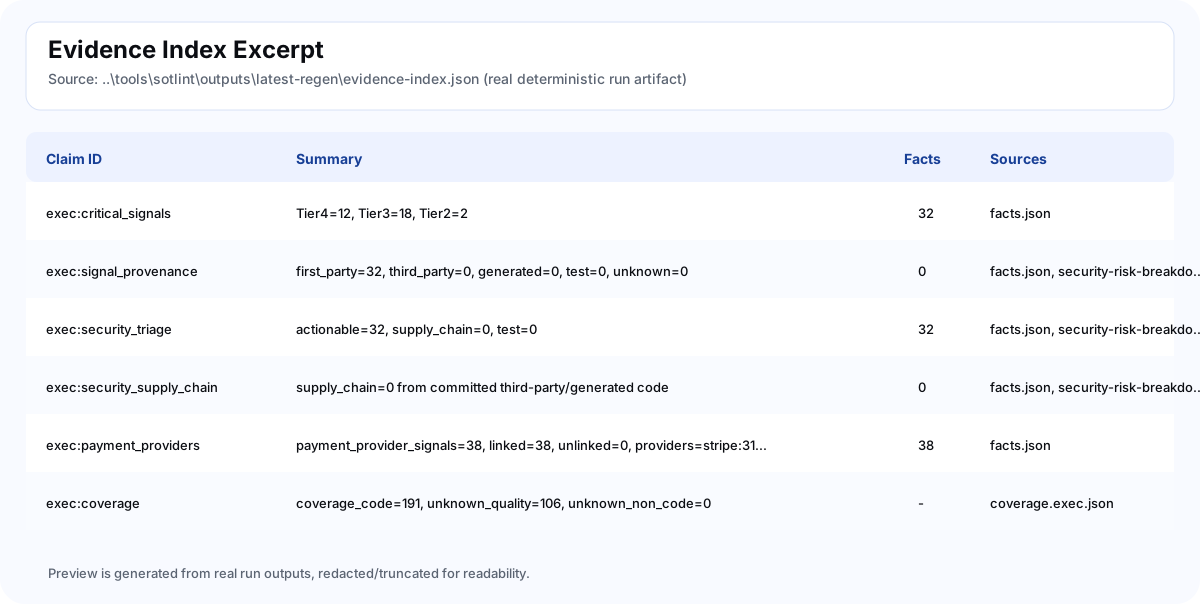
The SOT evidence-index pattern carries into consulting work: claims should have backing, and unknowns should stay visible.
Fit call
A useful first conversation is short: what are you building, what is stuck, what decision is coming, and what would count as a useful outcome?
Exploratory calls are fine. Paid work, private access, and delivery dates require proper commercial onboarding first.